

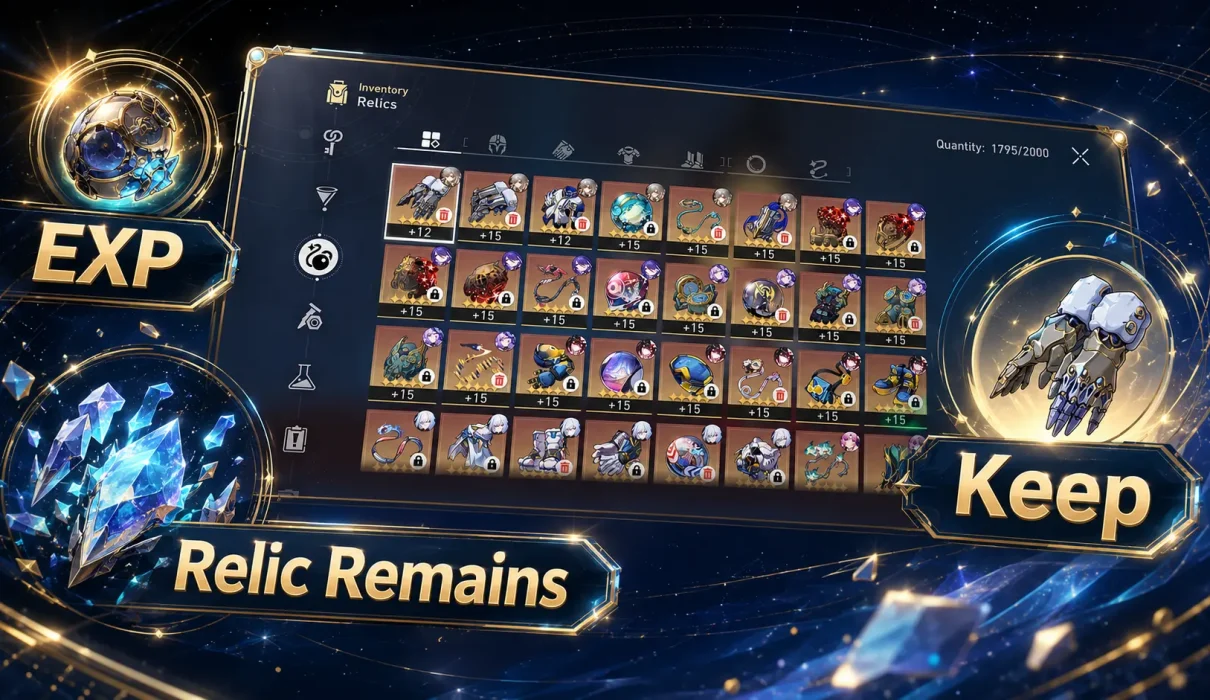
Last updated: July 17, 2026 | Mechanics reviewed in: Honkai: Star Rail Version 4.4 | Guide focus: Relic EXP, Relic Remains, 5-star relic decisions and safe inventory cleanup
When your Relic inventory is full, every unwanted piece creates the same question: should you salvage it for Relic EXP, convert it into Relic Remains, or keep it because a current or future character may use it?
The answer depends on your account’s real bottleneck. EXP lets you test and finish relics you already own. Relic Remains create more chances at a selected set and slot. Keeping too many speculative pieces fills the inventory again, while salvaging too aggressively can delete rare main stats, useful Speed pieces or strong role-based substat combinations.
This HSR relic salvage guide gives you a fast EXP-versus-Remains rule, verified salvage values, a practical keep checklist, upgrade stopping points and a six-pass workflow for clearing a full inventory without relying blindly on auto-select.
⚡ Quick Answer
Salvage 2-star to 4-star relics for EXP once you no longer need them. For unwanted +0 five-star relics, choose EXP if you are still building teams, testing many pieces or regularly running out of upgrade materials. Choose Relic Remains if your EXP stock is healthy and you need more targeted synthesis attempts. Ten +0 five-star relics equal either 15,000 Relic EXP or 100 Relic Remains—enough to synthesize one relic from a selected set and slot. Before salvaging, lock useful Speed pieces, Energy Regeneration Rate Ropes, strong role-based stat combinations and high-potential four-line starters.
⚠️ Rare Does Not Mean “Keep Forever”
Rare main stats deserve a manual comparison, not permanent protection. Once you own several copies in the same set and slot, keep the pieces with useful supporting substats or a clear future role and salvage the clearly weaker duplicates.
Contents
- 1 1. ⚖️ EXP vs Relic Remains: The Fast Decision
- 2 2. ♻️ Relic Salvage Rewards by Rarity
- 3 3. 🟣 When Should You Choose Relic EXP?
- 4 4. 🟡 When Should You Choose Relic Remains?
- 5 5. 🔒 What Relics Should You Keep Before Salvaging?
- 6 6. 🧪 Test Relics at +3, +6, +9 and +12
- 7 7. 🎲 Failed Enhanced Relics: EXP, Remains or Variable Dice?
- 8 8. 🧹 HSR Relic Inventory Full? Use This Six-Step Cleanup
- 9 9. ❌ Six Common Relic Salvage Mistakes
- 10 10. 📝 Sources and Update Notes
- 11 11. ❓ HSR Relic Salvage FAQ
- 11.1 Should I salvage five-star relics for EXP or Relic Remains?
- 11.2 How many Relic Remains does a five-star relic give?
- 11.3 How much EXP does a +0 five-star relic give?
- 11.4 Should I salvage enhanced relics?
- 11.5 What relics should I always check before salvaging?
- 11.6 What should I do when my HSR Relic inventory is full?
- 11.7 Can Relic Remains guarantee the main stat I want?
- 12 🌟 Final Takeaway
1. ⚖️ EXP vs Relic Remains: The Fast Decision
Relic EXP and Relic Remains solve different problems. EXP improves the candidates already in your inventory. Relic Remains create another candidate from a set and slot you choose. The correct output is therefore determined by whether your account lacks upgrade capacity or good relic candidates.
| Your Situation | Best Choice | Why |
|---|---|---|
| You regularly run out of Relic EXP | EXP | More crafted pieces only create a larger testing backlog. |
| Your core characters still use several +6 or +9 relics | EXP | Finishing usable equipment gives immediate account value. |
| You have a large EXP reserve and few pieces worth testing | Relic Remains | Targeted synthesis creates more relevant candidates. |
| You need one specific Body, Feet, Sphere or Rope slot | Relic Remains | You can choose the set and slot instead of farming random drops. |
| You are building your first two teams | Mostly EXP | Functional +12 and +15 relics matter more than luxury optimization. |
| Your main teams are complete and you are chasing marginal upgrades | Mostly Remains | Mature accounts usually need more candidates, not a larger unused EXP stockpile. |
| The relic has a rare main stat or a coherent high-value stat combination | Keep or test | Do not salvage it until you compare duplicates or reveal early rolls. |
Recommended Default Strategy
Use lower-rarity relics for EXP. While your main teams are unfinished, convert most clearly unusable five-star relics into EXP. Once you can test new drops comfortably, convert clearly dead +0 five-star relics into Relic Remains and keep an EXP reserve for future characters and upgrade sessions.
This hybrid approach avoids both resource traps. A pile of Relic Remains is not useful if you cannot level the pieces you synthesize. A huge EXP reserve is also inefficient if your real problem is obtaining a usable Energy Regeneration Rate Rope, Speed Feet or CRIT Body from a specific set.
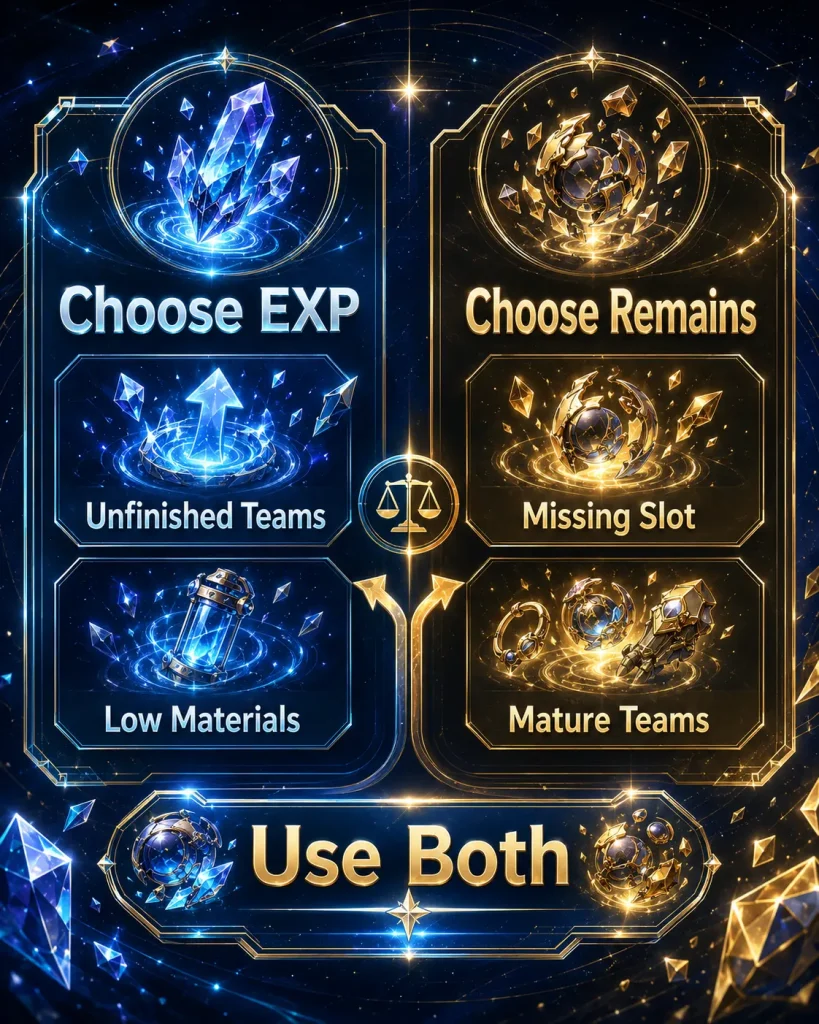
Image: Honkai: Star Rail © HoYoverse
2. ♻️ Relic Salvage Rewards by Rarity
Salvaging turns individual relics into stackable materials. This makes inventory cleanup easier and lets you decide whether an unwanted five-star relic should become immediate upgrade EXP or future crafting currency.
For a broader explanation of Caverns of Corrosion, Planar Ornaments, main stats and set bonuses, see the complete Honkai: Star Rail Relics guide.
2.1 How to Salvage Relics Safely
- Open the Relic inventory.
- Select Salvage.
- Apply rarity, set, slot or discard filters carefully.
- Review locked, equipped and rare-main-stat pieces before selecting a large batch.
- For eligible five-star relics, choose the output shown by the current interface.
- Read the final material preview and confirm only after checking the selected relic count.
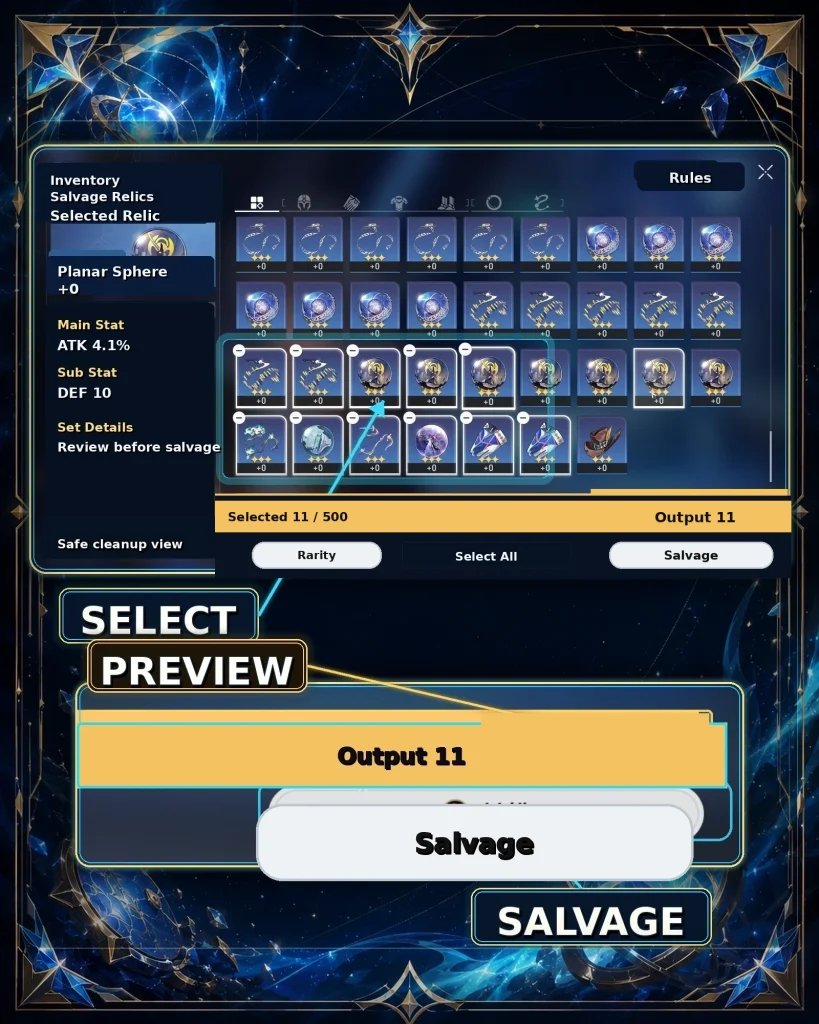
Image: Honkai: Star Rail © HoYoverse
2.2 Salvage Output and Base EXP Value
| Relic Rarity | Base EXP Value | EXP-Material Salvage Output | Relic Remains Option | Default Use |
|---|---|---|---|---|
| 2-Star | 300 EXP | 3 Lost Lightdust | No | EXP |
| 3-Star | 500 EXP | 1 Lost Gold Fragment | No | EXP |
| 4-Star | 1,000 EXP | 2 Lost Gold Fragments | No | EXP after replacing early-game gear |
| 5-Star at +0 | 1,500 EXP | 3 Lost Gold Fragments | 10 Relic Remains | Choose based on your bottleneck |
| Enhanced 5-Star | Includes invested EXP value | Use the current preview | Return rises with invested EXP; a +15 piece gives 400 Remains | Review individually |
Mechanics Note
Current references list a +0 five-star relic at 10 Relic Remains and a +15 five-star relic at 400 Relic Remains. Enhanced-relic interfaces and conversion rules have changed over time, so the value displayed in your Version 4.4 salvage preview should be treated as the final source of truth before confirmation.
2.3 The Real Cost of Ten Unwanted Five-Star Relics
- EXP choice: 15,000 Relic EXP.
- Relic Remains choice: 100 Relic Remains.
- 100 Relic Remains: one synthesized five-star relic from a selected set and slot.
In practical terms, 15,000 EXP takes one new five-star relic beyond +6 and close to +9. The alternative is one additional synthesized relic from a selected set and slot, with its main stat and substats still random unless you spend additional customization resources.
2.4 How Much EXP Does a Five-Star Relic Need?
| Upgrade Level | Cumulative EXP per Relic | Best Use |
|---|---|---|
| +3 | 2,400 EXP | Reveal the fourth substat or first roll |
| +6 | 7,500 EXP | Low-cost early testing |
| +9 | 17,500 EXP | Check whether the piece can become usable |
| +12 | 37,000 EXP | Functional builds and near-final evaluation |
| +15 | 76,000 EXP | Confirmed long-term pieces |
A complete six-piece five-star set requires 456,000 EXP to reach +15. That is why EXP remains valuable even for accounts that already own many relics.
3. 🟣 When Should You Choose Relic EXP?
Choose EXP when your account owns more promising relics than it can afford to test. This is common while building multiple characters, replacing early-game pieces or preparing a new team.
Choose EXP when…
- Your core characters still have low-level relics.
- You frequently stop at +3 or +6 because materials run out.
- You recently obtained a character who needs a full build.
- You have several promising pieces waiting to be tested.
- Your Relic Remains balance is already comfortable.
EXP is less urgent when…
- Your active teams already use completed relic sets.
- You hold enough materials for several testing sessions.
- Most new drops are obvious sidegrades rather than upgrades.
- Your weakest build is missing a specific set and slot.
- You regularly finish a farming session without finding anything worth leveling.
💡 Progression Rule
A functional +12 or +15 relic generally helps more than a theoretically perfect piece left at +0. If missing EXP prevents you from testing good candidates, crafting more candidates will not solve the bottleneck.
Early and midgame players should usually bias five-star salvage toward EXP until two teams have correct main stats and usable enhancement levels. Perfect substats can wait; unfinished builds cannot contribute their full value in Memory of Chaos, Pure Fiction or Apocalyptic Shadow.
4. 🟡 When Should You Choose Relic Remains?
Relic Remains become more valuable when EXP is no longer the main constraint. They let you synthesize a selected relic set and slot without spending more Trailblaze Power in a Cavern that may contain an undesirable second set.
Choose Relic Remains when…
- Your EXP reserve can support several new tests.
- You need one specific Body, Feet, Sphere or Rope.
- Your main teams are complete and improvements are rare.
- You farm a Cavern with a low-value companion set.
- Your inventory contains many clearly dead +0 gold relics.
What Remains can do
- 100 Remains synthesizes one selected set and slot.
- 800 Remains synthesizes one Self-Modeling Resin.
- The Self-Modeling Resin recipe is currently limited to two per month.
- Self-Modeling Resin can select an eligible main stat.
- Additional Resin can customize one or two substats under current rules.
⚠️ Relic Remains Do Not Guarantee a Good Result
Spending 100 Remains guarantees only the set and slot. Without Self-Modeling Resin, the main stat remains random. Even a customized main stat can receive poor substats or poor enhancement rolls.
Wishful Resin is no longer a separate current resource. Version 3.5 converted existing Wishful Resin into Self-Modeling Resin at a 1:1 ratio and consolidated relic customization around Self-Modeling Resin. Do not follow older guides that still describe Wishful Resin as a separate material.
This page focuses on the salvage decision. For detailed crafting priorities, use the dedicated guide on what to do with Relic Remains in HSR. For main-stat and substat customization decisions, see the HSR Self-Modeling Resin guide.
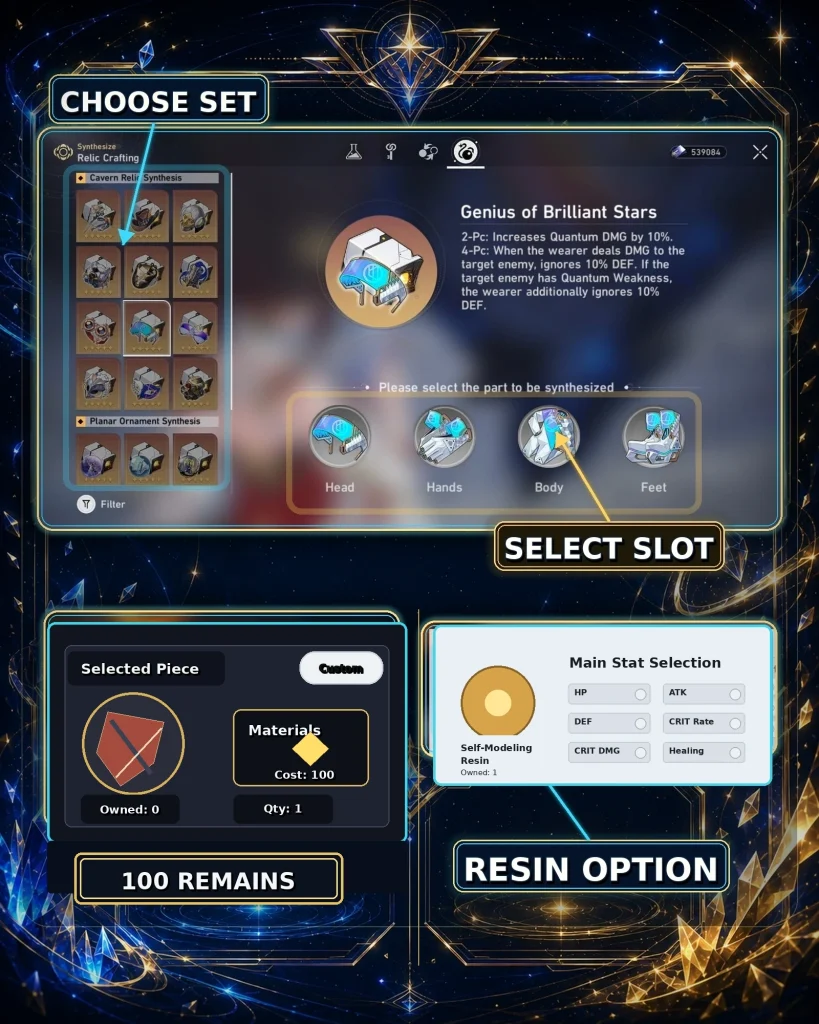
Image: Honkai: Star Rail © HoYoverse
5. 🔒 What Relics Should You Keep Before Salvaging?
A relic should have a clear reason to stay: a rare or correct main stat, a coherent role-based stat combination, a high upgrade ceiling, an active user or a realistic future use. “Maybe someday” is not enough when the piece has no identifiable build.
For deeper stat evaluation, compare pieces with the HSR Relic Stats guide. The same relic can be excellent for one archetype and useless for another.
5.1 Main Stats That Deserve Manual Review
| Slot | Main Stats to Review Carefully | Keep When… |
|---|---|---|
| Head / Hands | Fixed HP / fixed ATK | The piece has Speed, double CRIT or another coherent role combination. |
| Body | CRIT Rate, CRIT DMG, Effect Hit Rate, Outgoing Healing | The supporting substats match the intended role. |
| Body | ATK%, HP%, DEF% | The character scales from the stat and the piece has useful Speed, CRIT, EHR, Break Effect or survivability. |
| Feet | Speed | The piece has at least one or two useful supporting stats, or fills an important Speed target. |
| Feet | ATK%, HP%, DEF% | The set and substats fit a known slow build or character-specific scaling requirement. |
| Planar Sphere | Elemental/Physical DMG, ATK%, HP%, DEF% | The main stat fits a real kit and the substats support that role. |
| Link Rope | Energy Regeneration Rate | It has Speed, useful survivability or a rotation that needs ERR. |
| Link Rope | Break Effect, ATK%, HP%, DEF% | The substats match a Break, damage, sustain or support build. |
5.2 High-Value Substat Combinations
Damage Builds
- CRIT DPS: CRIT Rate + CRIT DMG, or CRIT + Speed/ATK%.
- Break DPS: Break Effect + Speed, with relevant ATK% or survivability.
- DoT DPS: Speed + ATK%, Speed + Effect Hit Rate, or ATK% + EHR.
- Follow-Up DPS: double CRIT, CRIT + ATK%, and Speed when the rotation benefits from it.
Support and Sustain Builds
- Debuffer: Speed + EHR, then Effect RES, HP% or DEF%.
- Harmony support: Speed + survivability, Effect RES and kit-specific scaling stats.
- Sustain: Speed + HP%/DEF%, with Effect RES where useful.
- Flexible support piece: Speed plus two other broadly useful role stats.
5.3 Three-Line vs Four-Line Five-Star Relics
A five-star relic can begin with three or four substats. A four-line starter sends all five enhancement rolls into existing substats. A three-line starter uses the +3 event to add its fourth substat, leaving four later enhancement rolls.
- Four lines with two premium stats: lock and test.
- Four lines with three role-relevant stats: strong keep.
- Three lines with double CRIT: test to +3.
- Three lines with Speed plus one useful stat: test to +3 if the main stat and set are relevant.
- Only one useful stat: test only when the main stat or slot is difficult to replace.
- No coherent role: salvage rather than hoping every future roll rescues the piece.
💡 Compare Duplicates, Not Just Rarity
Speed Feet and ERR Ropes are valuable, but you do not need unlimited bad copies. Sort by set, slot and main stat, then keep the versions with stronger supporting stats, better starting lines or a clear Speed-tuning purpose.
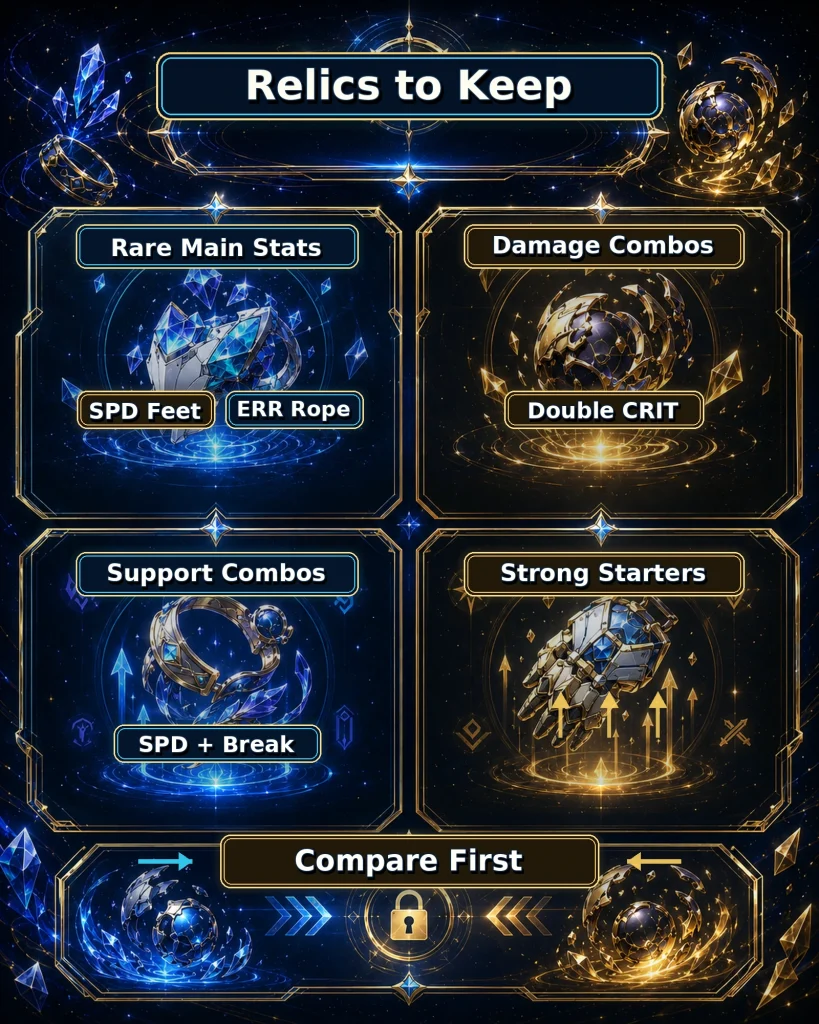
Image: Honkai: Star Rail © HoYoverse
6. 🧪 Test Relics at +3, +6, +9 and +12
The safest way to save EXP is to stop bad relics early. Do not treat enhancement as a choice between +0 and +15. Re-evaluate the piece at every substat event.
| Checkpoint | Continue When… | Stop When… |
|---|---|---|
| +3 | A useful fourth stat appears, or the first roll lands in a premium existing stat. | The new stat is irrelevant and the original starting lines were already weak. |
| +6 | At least one or two results support the intended role. | Both early outcomes miss and the remaining ceiling is too low. |
| +9 | The relic is already usable or can realistically beat your current piece. | Even ideal remaining rolls would not make it competitive. |
| +12 | The relic is functional, rare or one roll away from a clear upgrade. | The final +15 roll cannot change whether you would equip it. |
| +15 | The piece is confirmed for current use, Speed tuning or a credible future build. | Do not reach +15 automatically just because the relic began with attractive stats. |
❌ Do Not Chase Sunk Costs
Reaching +9 does not mean a relic deserves +15. Judge only whether the remaining EXP can realistically create a usable upgrade. The resources already spent should not force another bad investment.
A universal relic score can also hide character-specific needs. Use the HSR Relic Scorer guide as a comparison tool, but evaluate each stat according to the intended character, rotation and Speed target.
7. 🎲 Failed Enhanced Relics: EXP, Remains or Variable Dice?
Failed enhanced relics deserve a separate review because they contain invested EXP and may still have an excellent underlying stat layout.
| Enhanced Relic Condition | Best Default | Reason |
|---|---|---|
| Wrong main stat or no coherent substat role | EXP or Remains | The base relic is not worth rescuing. |
| Correct main stat but weak starting substats | Usually EXP | Redistributing enhancement rolls cannot fix a poor base. |
| Correct set, main stat and several strong starting substats, but rolls landed badly | Consider Variable Dice | The problem is enhancement distribution rather than the relic’s foundation. |
| Old temporary piece replaced by a clear upgrade | EXP if low; Remains if EXP is healthy | The account bottleneck determines the better recovered resource. |
| Rare ERR, Speed or elemental piece with niche value | Review before destroying | Rotation or future-build value may exceed the immediate salvage return. |
Variable Dice are best reserved for +15 relics with the correct main stat and multiple valuable starting substats where only the enhancement distribution failed. They should not be used to repair a weak base relic. Before spending this limited resource, verify the current Variable Dice rules in the in-game interface. Add the internal link to your Variable Dice guide after its outdated Wishful Resin references have been corrected.
8. 🧹 HSR Relic Inventory Full? Use This Six-Step Cleanup
A safe cleanup works best in passes. Trying to evaluate every piece individually from the start causes decision fatigue and makes accidental salvage more likely.
Step 1: Protect Equipped and Tuned Relics
- Lock relics equipped by active characters.
- Check characters whose builds were temporarily removed.
- Protect pieces used to reach specific Speed or Energy rotations.
- Protect alternate builds used in different endgame modes.
Step 2: Review Rare Main Stats
- ERR Ropes with Speed or useful defensive stats.
- Speed Feet with relevant supporting stats.
- CRIT Bodies with complementary damage stats.
- EHR Bodies for debuffers.
- Outgoing Healing Bodies with Speed or survivability.
- Elemental Spheres with coherent DPS stats.
Step 3: Lock Coherent Substat Combinations
- Double-CRIT pieces.
- Speed plus Break Effect.
- Speed plus Effect Hit Rate.
- Speed plus Effect RES and survivability.
- Four-line starters with at least two role-relevant stats.
Step 4: Compare Duplicates
Sort by set, slot and main stat. Keep the better starting lines, stronger Speed value, more useful role stats or the piece with a clear second user. Remove copies that are strictly weaker and have no separate tuning purpose.
Step 5: Test the Borderline Pieces
Upgrade uncertain relics to +3 or +6 in a controlled batch. Immediately mark failed tests for recycling instead of returning them to the general inventory.
Step 6: Split the Final Trash
- EXP pile: lower-rarity relics, failed tests and unwanted pieces when upgrade materials are low.
- Relic Remains pile: clearly dead +0 five-star relics when your EXP reserve is healthy.
- Review pile: rare main stats, strong bases and potential Variable Dice candidates.
💡 Do Not Finish With Hundreds of “Maybe” Relics
A relic should stay only when it has a rare or correct main stat, a coherent role, a strong starting combination, an active user or a realistic future build. Random stats that require an unknown future character to become useful are not a sufficient reason to keep it.
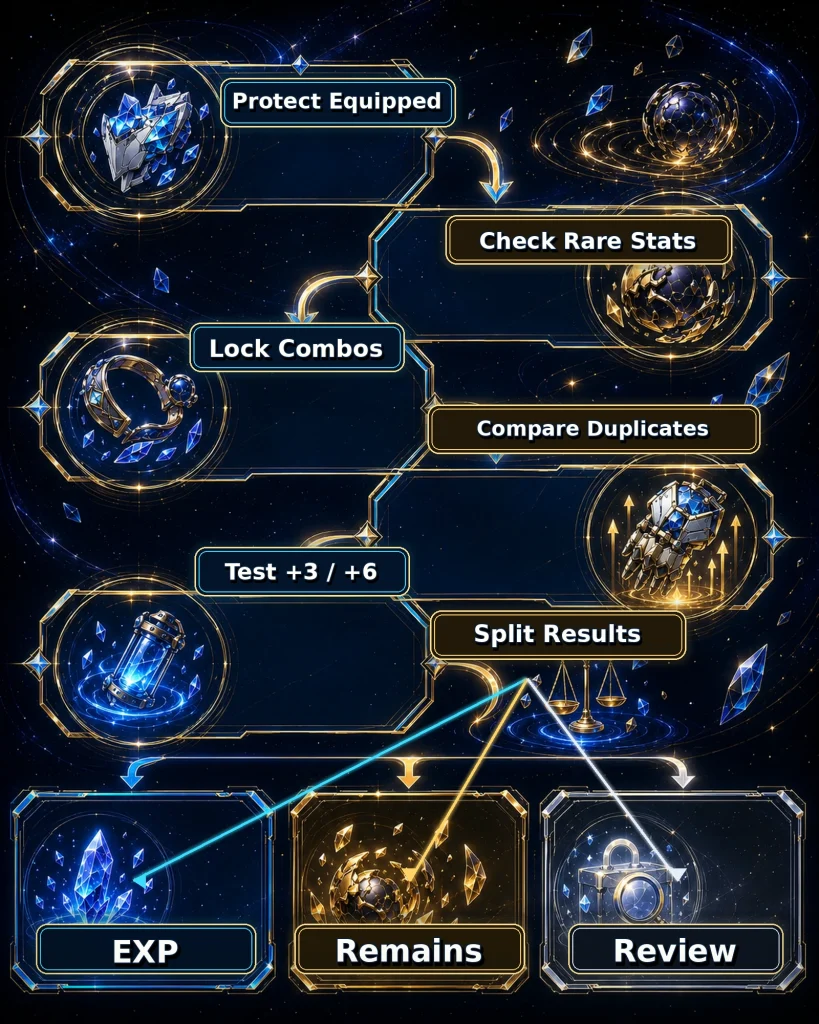
Image: Honkai: Star Rail © HoYoverse
9. ❌ Six Common Relic Salvage Mistakes
9.1 Salvaging Every Non-CRIT Relic
Supports, sustains, Break characters and DoT characters often value Speed, Break Effect, Effect Hit Rate, Effect RES, HP% or DEF% more than double CRIT.
9.2 Keeping Every Speed Foot or ERR Rope
These main stats deserve review, but weak duplicates still consume inventory space. Keep the versions with useful substats or a specific tuning purpose.
9.3 Converting Everything Into Relic Remains
Remains create more candidates; EXP reveals whether those candidates are usable. A synthesis-heavy strategy fails when you cannot afford to test the results.
9.4 Converting Everything Into EXP
A large EXP surplus does not solve a missing slot from a specific set. Mature accounts also need targeted opportunities.
9.5 Taking Every Attractive Starter to +15
Double CRIT or four starting lines only create potential. Stop when failed rolls make the relic unable to beat your current equipment.
9.6 Using Variable Dice on a Weak Base
Variable Dice redistribute enhancement outcomes. They do not fix the wrong main stat or turn several irrelevant starting substats into premium ones.
10. 📝 Sources and Update Notes
Numerical salvage and EXP values were cross-checked against current game-system references, while system changes were checked against official HoYoverse update information. Because the game displays the exact return before salvage, the current in-game preview should always override an older external table.
- Official Version 3.0 update: “Paean of Era Nova” Update — introduction of Wishful Resin and Variable Dice.
- Official Version 3.5 Update Radio: Version 3.5 relic-system changes — consolidation of Wishful Resin into Self-Modeling Resin.
- Official Version 4.4 news: Version 4.4 Trailer and version context.
- Honkai: Star Rail Wiki — Relic EXP: salvage values, base EXP and leveling costs.
- Honkai: Star Rail Wiki — Relic Remains: synthesis costs, monthly Self-Modeling Resin limit and Remains returns.
- Honkai: Star Rail Wiki — Self-Modeling Resin: current main-stat and substat customization rules.
Update policy: Recheck this page whenever HoYoverse changes Relic salvage, enhanced-relic conversion, Omni-Synthesizer costs, Self-Modeling Resin limits, Variable Dice or inventory automation.
11. ❓ HSR Relic Salvage FAQ
Should I salvage five-star relics for EXP or Relic Remains?
Choose EXP if you are still building characters, testing many relics or regularly running out of upgrade materials. Choose Relic Remains if your EXP supply is healthy and your main goal is obtaining another relic from a specific set and slot. Most accounts should use both outputs.
How many Relic Remains does a five-star relic give?
A +0 five-star relic gives 10 Relic Remains. Current references list a fully enhanced +15 five-star relic at 400 Relic Remains. Check the exact in-game preview before salvaging an enhanced piece.
How much EXP does a +0 five-star relic give?
A +0 five-star relic has a base value of 1,500 Relic EXP, equivalent to three Lost Gold Fragments.
Should I salvage enhanced relics?
Salvage an enhanced relic when it has no realistic user and is not a strong Variable Dice candidate. Choose EXP if upgrade materials are low; choose Relic Remains when your EXP reserve is healthy and the displayed crafting return is more useful.
What relics should I always check before salvaging?
Manually review useful Speed pieces, ERR Ropes, CRIT or EHR Bodies, elemental Spheres, double-CRIT starters, Speed plus Break Effect, Speed plus EHR, and four-line pieces with multiple role-relevant stats.
What should I do when my HSR Relic inventory is full?
Lock equipped and tuned relics, review rare main stats, protect coherent substat combinations, compare duplicates, test borderline pieces at +3 or +6, and split the final trash between EXP and Relic Remains.
Can Relic Remains guarantee the main stat I want?
Not by themselves. Spending 100 Relic Remains lets you select the set and slot. Self-Modeling Resin is required to select an eligible main stat, and current rules allow additional Resin to customize one or two substats.
🌟 Final Takeaway
The Best HSR Relic Salvage Strategy
- Use 2-star to 4-star relics as EXP once they are no longer needed.
- Choose EXP for unwanted five-star relics while your teams or testing queue remain underfunded.
- Choose Relic Remains for clearly dead +0 five-star relics once your EXP reserve is healthy.
- Keep relics with a clear main-stat, role, tuning or upgrade purpose—not vague future potential.
- Test uncertain pieces at +3, +6, +9 and +12 instead of rushing to +15.
- Review strong +15 bases for Variable Dice before destroying them.
- Maintain both EXP and Relic Remains reserves rather than maximizing only one resource.
Choose EXP when you need to finish or test what you already own. Choose Relic Remains when you need another targeted chance. Keep a relic only when its main stat, substats, upgrade ceiling or role justify the inventory space.
Honkai: Star Rail, its game systems, artwork and related assets are trademarks and copyrights of HoYoverse. This independent guide is not affiliated with or endorsed by HoYoverse.